© rev.com
2026.3.14
[追記] 2026.3.19
© rev.com
・ はじめに:OpenAIのサム・アルトマンCEOがBlackRock社のイベントに登場
・ アルトマン発言の要旨:AIは準公共サービス化するか
・ アルトマン発言をどう読むか:AI企業CEOからの「現場報告」
・ インタビュー内容全文の翻訳
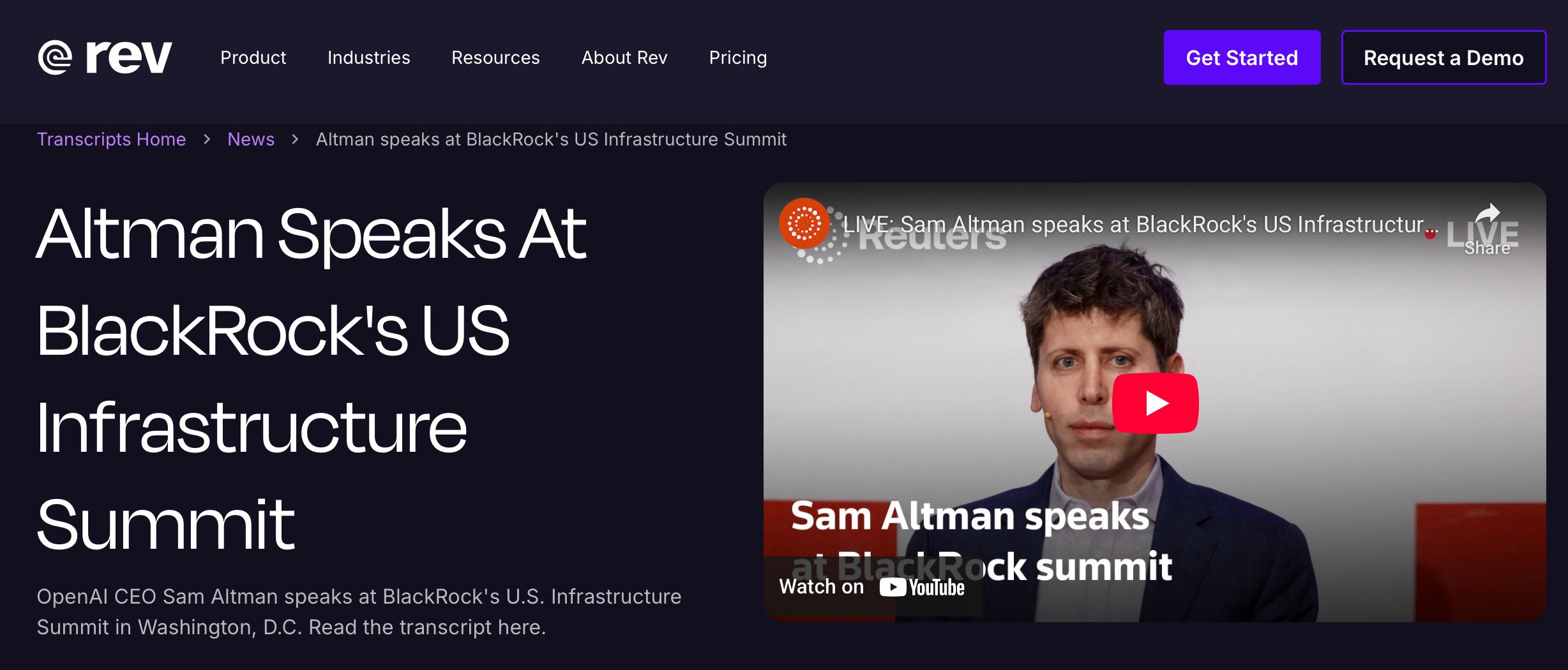
泣く子も黙る世界最強の黒岩さんこと、世界三大資産運用会社筆頭、BlackRock社が開催した「米国インフラサミット」にてOpenAIのサム・アルトマンCEOが登場し、スピーチ(インタビュー)を行った。
インタビュー内容は、AIによる未来社会を述べているのかと思いきや、内容を読んでみると筆者の想像した内容とはまったく違っていた。AIを提供し続けるには電力、データセンター、職人的人材が不可欠という、AIを社会インフラとして維持するために必要な要素をベタに説明するという内容だ。原文はこちらで参照できるが、Web記事はいつ唐突に消えるとも限らない。本稿の末尾にインタビュー全文を転載しておく。
(引用元はこちら:https://www.rev.com/transcripts/altman-speaks-at-blackrocks-us-infrastructure-summit)
BlackRockのイベントという場であるから、AI会社の代表であるアルトマンが呼びかけたのは投資であり、ようするに「発電や電力網の確保、データセンターの建設と維持、それらを実現する人材」のための投資を資産家に頼みたいという意図は明白だ。
アルトマンはインタビューで、AIが単なる「製品」ではなく「社会インフラ」となりつつあることを述べている。さらにはAIが社会インフラとして決定的な位置を確立するには、AIがどこまで賢くなるかではなく、AIを支える電力、データセンター(計算資源)といった物理的・エネルギー的な基盤、それに加えて人材、社会制度、特に民主的ガバナンス(統治)を含む、非AI的な世界──つまりこの現実の世界をどう設計するかにかかっていると一貫して主張している。
もちろん、投資家向け会議という場であるから、アルトマンには投資を呼び込みたい目論見があることが当然のことだが、アルトマンの発言は、AIに関する技術的な話というよりも、近未来社会へ投げかけた文明論として解釈できる。私たちのようなAIユーザーの一般市民、言い換えるなら、人数ベースで社会の大半を占める普通の消費者である私たちが、アルトマン発言に対してどう感じ、どう考えるかは、自分たちの未来を想像するきっかけになると思う。
本稿ではまず、アルトマンがBlackRockのサミットで何を語ったかを整理してみよう。段落の頭に付けた「◆」の記号は、その段落の内容が筆者の見解ではなく、アルトマン自身の発言に基づく内容であることを示している。本稿では直訳ではなく、意訳(あるいはやや超訳気味)で前後のつながりを整理しながらまとめた。
◆ 企業経営者や国家の首長、さらには高度な専門分野を持つ研究者まで、AIなしでは職務を遂行できない時代に突入している。ただし、「AI社長」や「AI首相・AI大統領」が登場する話ではない。最終判断をして責任を負うことや、その決断につながる価値判断は人間が担う。
◆ そうしたAIを活用する人間には、役割として多数のAIを監督し、成果物をどう信頼するかを判断し、判断基準となるガイドラインをAIに与える存在としての役割が求められる。つまりAIは、本来は人間が行っていた仕事の代行者ではなく、成果物の価値を高める増幅器となる。人間は判断と責任の最終的な担い手になる。
◆ OpenAI社の内部でも、まずはAIに質問することが当然のことになっている。AIは検索ツールではなく、ユーザーにとって「思考のパートナー」だ。新しい戦略や事業のアイデアは、まずAIに投げ込まれる。AIは断片的な内容ではなく、プロンプトが完全な文脈に近づくほど思考の質が高まることがわかっている。フル文脈とは、組織内の文書、コード、顧客データ、コミュニケーション内容などだ。
◆ AI産業の最大の難点は、インフラが非常に高価であることと、前倒しでの投資が必要な点に尽きる。だからOpenAIは、収益化より先に巨額のインフラ投資を行ってきた。これは一見すると、不自然な事業判断に見えるだろう。その理由は「知能は豊富であるべき」という考えに基づいているからだ。目標は「それ(知能)を使うこと自体を意識しなくなるほど当たり前にする」ことだ。
◆ ではAI産業のビジネス的な正体は何か。知能を電気や水と同じ様に使用・消費する「ユーティリティ(公益的サービス)」の一種になることだ。人々は水や電気と同じ様に、メーター課金で知能を利用するだろう。このとき、供給量が足りないと高価格化や富裕層への集中が起こり、中央集権的な配分という「望ましくない未来」が訪れかねない。
◆ では対策は何か。それは供給量を増やし、市場を満たすことである。その実現を阻むのは、現実としてのインフラ問題だ。第一に、ギガワット級データセンターは、その規模や複雑さ、人手による調整業務など全てが桁違いに重い。天候などの自然環境、サプライチェーン、そして人材などの現実世界で生じるトラブルの全てが必ず発生する。これまでのOpenAIの発展は、多様な組織が短期間で協力し、課題を克服して乗り越えてきたからにほかならない。
◆ つまり、AIの発展は、ソフトウェア革命である以前に巨大な物理インフラ革命なのである。すでに数年前と比べて今では、同じ問題を解くコストが1000分の1になった。つまり電力消費と効率性は1000倍も改善した。長期的には電力確保に問題はないと楽観的に見ている。つまり発電の方法として、ガス、太陽光、核分裂(従来からある原子力発電)、核融合(現在開発が進んでいる放射性廃棄物の出ない原子力発電。太陽は内部で核融合を起こしている)がその代表的な方法だ。長期的にはよいが、短期的には1ワットあたりの効率の改善が必要だ。
◆ OpenAIの演算装置(計算資源)は推論専用ではない。最速でも最強でもなく、電力効率の良さで判断している。消費電力をいかに節約しつつ効果を最大化するかが問われるこの時代において、電力効率の良さは決定的な差を生む。
◆ AIの裏側には人の仕事がある。発電所、送電、冷却装置、そして建設だ。発展の維持における最大のハードルは技術者不足だ。どのボトルネックの解決や発展でも、最終的にはその分野の熟練職人の人数へと問題が収斂する。OpenAIでは労働組合と提携して、人材育成の加速に努めている。AI時代においても、肉体労働を担う技術者の価値は下がらない。
◆ 一方で、深層学習は秘密技術ではない。これは発明ではなく、物理法則のような発見である。この原理は誰にでも理解可能なもので、その応用によって差がでる。たとえば製造業、事業の運営、ワークフローの統合やインフラ事業など。
◆ 米国は現在、最先端のモデルを開発し運用しているが、中国は低コストで推論モデルを運用し、オープンソースだ。競争の最中にある。インドもスタートアップの攻めの姿勢で取り組んでいる。極端な例として、1人起業ではなく、AIによるゼロ人企業さえ発想として存在する。これは米国と同じ方向性を持っているが、そのスピードは尋常ではない。
◆ AIは社会の何を変えるか。経済、地政学、生活様式を根本からひっくり返しうる存在だ。だから特定の企業や政府だけでAIの方向性を決めるべきではない。民主的プロセスによる合意形成が必要だ。企業はテクノロジーの専門家として助言する立場であり、AIの持つ危険性や技術的限界を説明する責任を持つ。
◆ AIはすでに「準・公共インフラ」と位置付けられる存在だ。AIによって生活の質は向上するが、GDPは下がる可能性がある。知能がデータセンターに集約される社会においては、従来型の指標は意味を失うかもしれない。人類はAIの時代の到来において、「不足を管理する社会」から「豊富さを管理する社会」へ移行すると考えられる。
◆ しかし、その移行過程において短期的には激しい痛みと苦痛を伴い、社会全体を巻き込んだ議論が不可避だ。AIによって雇用の変化は起きる。だが悲観論に陥る必要はない。資本主義を悲観する必要もない。社会の再設計が求められている。これは破綻でも崩壊でもなく、次の時代への移行において必ず体験する現象だ。
筆者を含む普通のユーザー、言い換えるなら一般市民の関心はAIはどのように使えるのか、AIは本当に賢いのか、我々の仕事(雇用)を奪うのか、どのようなアプリ(ケーション)が登場するのかといったことに関心が向きがちだ。これは機能や体験に関することである。
しかしこのインタビューにおいてアルトマンの視座は、一貫してAIを大量かつ安定に供給すること、その実現には電力、データセンター(計算資源)、人材、サプライチェーン(物資等の供給網)をどう安定的に確保するかに向いている。そしてAIを現実の社会制度の中でどのように位置付けるかに集中している。つまりアルトマンが技術者でも未来論者でもなく、巨大インフラ事業の経営者という立場で語られている。
ユーザーである一般市民にとって想像しにくい点が、アルトマン発言によって炙り出される。ユーザーの気づきにくいこと。それはAIの裏側には発電所、送電網、冷却設備があり、建設労働者がいて、変圧器や半導体工場が関わっているという物理的な重い世界で成り立っているということだ。
アルトマンはAIをソフトウェア革命や知能革命ではなく、19世紀に登場した電力網や20世紀に急拡大した石油とその製品の流通や、情報の通信網と同じような文明社会の公共インフラと位置付けて語っている。一般のユーザーにはほぼ見えない裏側の世界だ。
AIは公共インフラであると考えることは、アルトマン自身の思想であると同時に、切実な経営課題という経営者としての訴えだ。アルトマンは「需要は伸びているが、供給が追いつかない」「供給不足だと、売れず、高価になり、富裕層に偏り、政治介入が起こる」と述べている。この真意は「計算資源を制したものがAIの未来を制す」という状況にすでに突入してることを示す。だからアルトマンは経営者として、AIそのものの研究開発と同等かそれ以上に電力、データセンター、技能職人材の育成、政府との関係性を重視しているのだといえる。
このインタビューを斜め読みするだけでは、「AIは物理法則の発見と似ている」「知能は電力や水のような公益サービスになる」「民主的なプロセスが必要」といった発言から、このインタビューが思想的・哲学的に見えるかもしれない。実際、内容も抽象的な部分が多い。
しかし実際には、AI業界を主導する立場として、彼の発言は現実的な読みに基づく。つまり次の3点だ。
1 原理は共有される。これは、特定企業による技術の独占は長くは続かないことを意味する。
2 AI同士の差は運用とインフラに現れる。これは、資本と国家の問題へと収斂する。
3 民主的プロセスによる合意が必要。これは、一企業では背負いきれない責任を負う未来の到来への指摘だ。
つまりこれはAI未来論ではなく、この先5〜10年程度の間のスパンで起きる予測であり、AI企業が存続するための前提条件を整理していると考えられる。
その証左は、このインタビューが投資家向けサミット、それもインフラ投資家が集うBlackRock社のイベントで実施されたものだという点にある。BlackRockは長期的資本、インフラ投資、公共性と収益性の両立を扱う。このような投資家向けサミットであるから、一般市民に向けた場でも技術カンファレンスでもない。想定される主要な関係者は政府機関、労働組合等の組織、エネルギー関連企業だ。アルトマンは「AIはすでに、スタートアップ企業の話ではなく、国家・資本で考えるインフラの話である」というメッセージを聞き手に向けて発信している。ベンチャーキャピタルの世界からの卒業宣言でもある。
総括しよう。このインタビューはAI未来像ではなく、AI企業経営者からの現場報告であり、投資家への要請だ。アルトマンはこのインタビューで、AIへの賛美やエヴァンジェリスト的発言を特にしていない。単に経営上の課題と、今後起こり得ると想定されることについて語っている。短期的ROI(投資利益率)型のIT投資の話でもない。長期的な次世代文明への先行的な資本投入の話をしている。
派手さもなく、あまり胸踊る様な内容ではない。しかし電力・建設・人材・政治・社会制度について話しているという事実が、AI産業が「次の段階へと進んだ」ことを雄弁に語っている。OpenAIはIT企業から、公共インフラ事業者へと変貌しつつある。アルトマンの説明から筆者は経営者自身が包み隠さず説明する透明性の高さを感じる。
アルトマンのインタビューがrevにて公開されてから約1週間が経った。その間に湧き上がったテクノロジー業界やインフラ業界側からの反応をリサーチしてみた。
まず見られるのが、このインタビューを解説する記事だ。本稿のような形で、AIモデルの話から電力・インフラ・ガバナンスへと論点が移ったと説明するものが散見された。一例のリンクを示す。
次に見られたのが、「思考に課金の是非」を問うような、やや反発的な論調のものだ。知能に値札と請求書が付くというイメージで語られ、ディストピア的であるという。以下に例を示す。特にGizmode記事の後半に書かれている「アルトマン氏とサラ・フライアー氏(OpenAI CFO)が連邦政府が保証人になるだろうと発言した。その後二人は「(OpenAIが)大きすぎて潰せない企業」として扱われるべきという示唆を撤回したが、AIを公共事業と位置付けることは政府補助を求めるを暗に認めていることなる」という指摘な納得できる。
https://www.indy100.com/science-tech/sam-altman-openai-chatgpt-latest
3つ目が、ドラマ「Black Mirror」のようだという一般ユーザー層の反応だ。以下に例を示す。
https://en.walaw.press/articles/altman_says_ai_will_be_sold_by_usage_like_electricity/GQPRXXMRWPMM
AIの公共化は、比喩として便利な表現だが、課金制度を連想させ、格差と支配の変化について話していると捉えられている向きがある。
一方で、アメリカではデータセンターが電気料金を押し上げているという反発があり、政治的な争点にもなっている。AIのデータセンターが電気代を押し上げているならば、その負担は誰がすべきなのか、という論点もここに入り込んできている。
一般消費者レベルでは「AIって便利だな」「AIを使って情報漏洩になったら怖いな」といった観点がまだまだ多い。だがアルトマンは「AIは公共サービスで、課題は電力・建設・人材です」と語る。我々のような普通の市民とは次元の違う話をしている。だが、AIはタダで使える魔法(もちろん課金型サービスもある)ではなく、従量課金の準公共サービスへと変化していることを知っておきたい。
一般企業の経営者の観点ではどうか。AIは業務効率化・DX(デジタル変革)のためのツールという段階を過ぎ、「新しい依存先」となりつつあることを意識しておきたい。会社はいずれ、AI依存=クラウド+電力+サプライチェーンへの依存という図式になり、AI供給は事業継続に直結する。つまりDXがひと段落すると、今度は調達・事業継続・変動価格への対応が経営者を悩ませるかもしれない。
つまり、次の観点はパッと考えられるだろう。
・AIが使えなくなったら、どの業務が止まるのか?
・AIの利用量が倍になったら、コストはどう変わるか?
・AIの規制が強化された場合、代替手段はあるか?
AIが普及すればするほど、AI供給側(AI企業)では計算資源がボトルネックになる。ボトルネックになれば、価格が上がり、富裕層向けに偏っていく。アルトマンは、そうならないためにも電力・データセンター・人材への投資を呼びかけている。
オリジナルはリンク先をご参照ください。下記の転載は、リンク先ページが閲覧不能な場合に備えたものです(本稿の主旨は、このインタビュー内容に基づいているため)。対訳も掲載しました。訳にはDeepLを使用しましたが、もし誤訳があればそれは筆者の責任です。
https://www.rev.com/transcripts/altman-speaks-at-blackrocks-us-infrastructure-summit| Interviewee (00:00): … The other one is when can a CEO of a major company, a president of a major country, a Nobel Prize winning scientist, when can they not do their job without making heavy use of AI? This doesn't mean that there will be an AI CEO or an AI president, but it does mean that the role of, let's say a human CEO, when I think about my job, it's really quite different. You still do need a person to stand behind decisions and kind of exercise human judgment and all of the understanding that we expect out of someone running an important organization to do. |
アルトマン (00:00): …もう一つは、大手企業のCEOや主要国の大統領、ノーベル賞受賞科学者といった人々が、AIを多用せずに職務を遂行できなくなるのはいつなのか、ということです。これは、AIがCEOや大統領になるという意味ではありませんが、例えば人間のCEOという役割について、私が自分の仕事を考えるとき、そのあり方は以前とはかなり異なってくるということです。重要な組織を率いる人物に期待されるような、意思決定の背後に立つ人間や、人間的な判断力、そしてあらゆる理解力を発揮する存在は、依然として必要不可欠なのです。 |
| (00:40) But the actual parts of my role that I will increasingly have to rely on an AI to do, because no human can. No human CEO can talk to every employee at a company, every customer, be in every meeting, be an expert in every field. And so more and more, I think of these jobs will be supervising a bunch of AI, providing oversight, deciding how to trust the outputs, how to provide guidance. And that threshold of when you really wouldn't want to be doing your job, running a large organization without heavy reliance on AI, I think that's another sort of interesting threshold that may take a little bit longer, but probably not a lot longer. | (00:40) しかし、私の役割の中で、人間には不可能なため、今後ますますAIに頼らざるを得なくなる部分があります。CEOとして、社内の全従業員や全顧客と対話したり、すべての会議に出席したり、あらゆる分野の専門家になったりすることは、人間には不可能です。ですから、こうした仕事はますます、多数のAIを監督し、全体を見渡し、その出力をどのように信頼すべきか、どのように指導すべきかを決定することになっていくと思います。そして、AIに大きく依存せずに大規模な組織を運営するという仕事を、もはや本当にやりたくないと思うようになるその境界線。それはまた別の興味深い境界線であり、そこへ到達するにはもう少し時間がかかるかもしれませんが、おそらくそれほど長くはかからないでしょう。 |
| Interviewer (01:30): And as you do your job, how much are you finding yourself relying on some of the agents and some of the artificial intelligence that we are developing at OpenAI? |
インタビュアー (01:30): そして、仕事をする中で、OpenAIで開発しているエージェントや人工知能に、どれほど頼っていると感じますか? |
| Interviewee (01:42): It's ramping incredibly quickly. If I have a new idea for a business model, a strategy shift, a product offering we should do, the very first thing I do before I even bounce it off somebody else is to ask our tools. And as they get more context, and I think this really is the next big thing to happen, is they can get close to full context of our company, access to all of our internal docs, communication, code, customer data, everything, the quality of the answers, thought, whatever you want to call it, gets better and better. |
アルトマン (01:42): その普及スピードは信じられないほど速いです。ビジネスモデルや戦略の転換、あるいは展開すべき新製品について新しいアイデアが浮かんだとき、私はまず誰かに相談する前に、自社のツールに尋ねます。そして、ツールがより多くの文脈を把握するにつれて――これはまさに今後起こる大きな変化だと私は考えています――当社の全容に近づき、社内のあらゆるドキュメント、コミュニケーション、コード、顧客データなど、あらゆる情報にアクセスできるようになるにつれて、回答の質や思考の深さ、あるいはそれを何と呼ぶにせよ、その精度はますます向上していくのです。 |
| Interviewer (02:20): Right. Okay. So let's shift a little bit. Two weeks ago, now it's a $110 billion funding round. I asked ChatGPT, how does that compare to any other fundraising that's been done in the public markets? |
インタビュアー (02:20): なるほど。では、話題を少し変えましょう。2週間前、1,100億ドルの資金調達ラウンドが発表されました。そこでChatGPTに、「これは公開市場で行われた他の資金調達と比べてどうなのか」と尋ねてみました。 |
| Interviewee (02:37): I actually don't know. |
アルトマン (02:37): 実はよく分かりません。 |
| Interviewer (02:39): Four times as large. Okay. The largest public offering ever done was roughly 25 billion that Aramco did several years ago. And the public markets are supposed to be the broadest and deepest sources of capital. Okay? Three strategic partners, Amazon, NVIDIA, and SoftBank. Tell us a little bit about this. How is this an inflection point of the company? And one of the questions somebody asked me is, what are we spending all that money on? |
インタビュアー(02:39): 4倍の規模ですね。わかりました。これまでで最大のIPOは、数年前にアラムコが行った約250億ドル規模のものでした。そして、公開市場は最も広範かつ流動性の高い資金調達源であるはずですよね。いいですか? 戦略的パートナーは、アマゾン、NVIDIA、そしてソフトバンクの3社です。これについて少しお聞かせください。これは同社にとってどのような転換点となるのでしょうか? また、ある人から「その巨額の資金を何に使うのか」と質問されました。 |
| Interviewee (03:12): There's many hard parts of this business, but one of the hardest ones is the infrastructure is so expensive. You need so much of it and you have to commit so far in advance. I have never seen any other industry quite like this. I mean, there have been clearly many capital intensive industries throughout history, but as I look at what's to come in front of us in future years, if the ramp stays as steep as it looks like it is right now, the demand is growing as fast as it's growing, you have to do some pretty unusual things. OpenAI does a lot of things that look weird. We spend a ton of money on infrastructure in advance of revenue. We do new business models like ads that seem like maybe not the most profitable thing we could do. A long list of other things, but we have this fundamental belief in abundance of intelligence and that one of the most important things in the future is that we make intelligence, to borrow an old phrase from the energy industry that didn't quite work, too cheap to meter. |
アルトマン (03:12): この業界には困難な点がたくさんありますが、中でも最も大変なのは、インフラのコストが非常に高いことです。膨大な量のインフラが必要で、しかもかなり前から計画を固めなければなりません。これほど極端な業界は他に見たことがありません。歴史上、資本集約的な産業は確かに数多く存在してきましたが、今後数年間に待ち受ける状況を考えると、現在の急勾配な成長曲線が維持され、需要がこれほど急速に拡大し続けるのであれば、かなり異例の手法を取らざるを得ません。OpenAIは、一見奇妙に見えるようなことを数多く行っています。私たちは収益化に先立って、インフラに莫大な資金を投じている。広告事業のような、おそらく最も収益性の高い事業とは言えないかもしれない新しいビジネスモデルにも取り組んでいる。他にも数え切れないほどの取り組みがあるが、私たちには「知能の豊富さ」に対する根本的な信念があり、未来において最も重要なことの一つは、エネルギー産業でかつて使われた(あまりうまくいかなかった)古い表現を借りれば、知能を「計測不能なほど安価」なものにすることだと考えている。 |
| (04:22) We want to flood the world with intelligence. We want people to just use it for everything. We want this to just be something that the future generation doesn't think about. They expect everywhere and everybody has access to geniuses, as many as they need in any area that they need. And this principle, which is one of our kind of top guiding principles, does lead to a lot of behavior that would look less natural for other companies. And one of those is we really want to get out of this world that we have been in that we still think we are on a trajectory to stay on without changing what we do, of always being capacity constrained. | (04:22) 私たちは、世界中に知能を溢れさせたいと考えています。人々に、あらゆる場面でそれを活用してほしいのです。そして、将来の世代にとっては、それが当たり前のものになってほしいのです。彼らは、どこにいても、誰であっても、必要な分野で必要なだけ、天才たちの知恵にアクセスできることを当然のこととして期待するようになるでしょう。そして、この原則——それは私たちにとって最も重要な指針の一つですが——は、他社から見ればあまり自然ではないと思われるような行動を数多く生み出します。その一つが、私たちがこれまで居続けてきた世界から脱却したいという強い思いです。つまり、何も変えずに現状の軌道をそのまま進み続け、常にリソースの制約に縛られているという状況から抜け出したいのです。 |
| Interviewer (05:00): Right. And capacity constrained, you mean compute? |
インタビュアー(05:00) なるほど。容量の制約というのは、計算(演算)能力のことですか? |
| Interviewee (05:03): Yeah. |
アルトマン(05:03) はい。 |
| Interviewer (05:04): And I've often heard you say a lot that compute is revenues. You want to talk a little bit about how you think about that? |
インタビュアー(05:04): 「計算能力こそが収益源だ」と、あなたはよくおっしゃっていますね。その点について、どのようにお考えなのか、少しお話しいただけますか? |
| Interviewee (05:14): Fundamentally, our business, and I think the business of every other model provider is going to look like selling tokens. They may come from bigger or smaller models, which makes them more or less expensive. They may use more or less reasoning, which also makes them more or less expensive. They may be running all the time in the background trying to help you out. They may run only when you need them if you want to pay less. They may work super hard, spend tens of millions, hundreds of millions, someday billions of dollars on a single problem that's really valuable. |
アルトマン(05:14) 基本的に、私たちのビジネス、そして他のすべてのモデルプロバイダーのビジネスも、トークンの販売のような形になると思います。モデルは規模の大小によって異なり、それによって価格も高くなったり安くなったりします。また、推論の複雑さによっても価格が変わります。モデルはバックグラウンドで常時稼働し、ユーザーを支援しようとする場合もあります。あるいは、費用を抑えたい場合は、必要な時だけ動作するようにすることも可能です。また、非常に価値の高い単一の問題に対して、数千万、数億、将来的には数十億ドルもの巨額を投じて、懸命に取り組むこともあるでしょう。 |
| (05:46) But we see a future where intelligence is a utility like electricity or water and people buy it from us on a meter and use it for whatever they want to use it for. The demand that we see for that seems like it's going to continue to just go like this. And if we don't have enough, we either can't sell it or the price gets really high and it kind of goes to rich people or society makes a bunch of sort of central planning decisions that I think almost always go badly about, we're going to use our limited impute supply for this and not that. So the best thing to me throughout all the history of capitalism, innovation, whatever you want, is to just flood the market. | (05:46) しかし、私たちは、知能が電気や水のような公共サービスとなり、人々がメーターを通じて私たちからそれを購入し、好きな用途に自由に使えるような未来を想定しています。その需要は、今後もこのまま伸び続けていくと思われます。もし供給が足りなければ、売れないか、あるいは価格が跳ね上がって富裕層だけが利用できるようになるか、あるいは社会が「限られた供給をこれに使って、あれには使わない」といった中央計画的な決定を下すことになるでしょう。しかし、そうした決定はたいてい失敗に終わります。ですから、資本主義やイノベーションの歴史を通じて、私にとって最善の策は、市場に供給を溢れさせることだと考えています。 |
| Interviewer (06:35): Yeah. And obviously a critical part of addressing that compute demand is Stargate. And this is an infrastructure conference and you announced that several months ago, or almost a year ago, I guess it was. Yeah. How's it going in the US? And then how is it going because there's also Stargate in Abu Dhabi. |
インタビュアー(06:35) そうですね。そして、そのコンピューティング需要に対応する上で、Stargateが重要な役割を果たすことは明らかです。ここはインフラ関連のカンファレンスですが、その件については数ヶ月前、いや、確か1年近く前に発表されました。そうですよね。米国での状況はいかがですか? また、アブダビにもStargateがあるとのことですが、そちらの状況はいかがでしょうか。 |
| Interviewee (06:59): Yeah. Yeah. Honestly, there's many cool parts of the job. One of the coolest is getting to go visit these mega data centers under construction and operation. Just the scale of these gigawatt campuses. It's really hard to explain and you see these photos and it's like, "Okay, it does look big." And then you go there and you're walking through it from building to building and it's just 10,000 people there, all these different skilled trades doing all these different things. And it looks like a spaceship inside. It's really quite incredible. We are training right now on the first site in Abilene, what I think will be the best model in the world, hopefully by a lot. And it's so amazing to have gone from many visits while it was under construction and just really internalizing the scale and incredible complexity to the day that one researcher at OpenAI types in like one command and it pushes enter, unbelievable number of GPUs spin up and start doing this one huge computation altogether. It's very cool. |
アルトマン: はい。そうですね。正直なところ、この仕事には魅力的なところがたくさんあります。中でも特に素晴らしいのは、建設中や稼働中の巨大データセンターを見学できることです。ギガワット規模のキャンパスというそのスケールは、言葉ではなかなか説明しきれません。写真を見れば「ああ、確かに大きいな」とは思うのですが。でも、実際に現地に行って、建物から建物へと歩き回ってみると、そこには1万人もの人々がいて、様々な専門職の人たちがそれぞれの仕事をこなしているんです。内部はまるで宇宙船のようで、本当に信じられないほどです。現在、私たちはアビリーン(註:テキサス州の都市)にある最初の施設でトレーニングを行っています。ここは、おそらく世界最高のモデルになるだろうと私は考えています。できれば、他を圧倒するほどに。建設中の現場を何度も訪れ、その規模と信じられないほどの複雑さを肌で感じていた日々から、OpenAIの研究者がたった一つのコマンドを入力してEnterを押すだけで、信じられないほどの数のGPUが起動し、一斉にこの巨大な計算を処理し始める日へと至ったことは、本当に素晴らしいことです。とてもクールですね。 |
| Interviewer (08:04): And what have been the most pleasant surprises and what have been the hardest things about getting it up and running and scaling it going forward? |
インタビュアー (08:04) また、このプロジェクトを立ち上げて運用し、今後スケールさせていく上で、最も嬉しい驚きは何でしたか? それから、最も大変だったことは何でしたか? |
| Interviewee (08:16): I mean, there have been all the expected challenges and then the unknown unknowns. There was a crazy weather event in Abilene that was outside what we had planned for and that brought things down for a little while. There's all of supply chain challenges. Anything at this scale, it's just like so much stuff goes wrong. Lots goes right, but just trying to build something around the clock with such complexity, there's all the stuff that goes wrong. One of the biggest surprises on the upside is how many different organizations had to come together to do this in an incredibly short period of time, and how much we all ended up working together as one team under a lot of pressure. |
アルトマン(08:16): 予想通りの課題はもちろん、想定外の事態も次々と発生しました。アビリーンでは、計画の範囲を超えた異常気象に見舞われ、一時的に作業が停滞してしまいました。サプライチェーンに関する課題も山積みです。これほどの規模のプロジェクトでは、どうしても様々な問題が起きるものです。うまくいくこともたくさんありますが、これほど複雑なものを24時間体制で構築しようとすれば、やはり様々な問題が発生するものです。一方で、最も大きな驚きの一つは、信じられないほど短い期間でこれを実現するために、どれほど多くの異なる組織が協力し合わなければならなかったか、そして、多大なプレッシャーの中、私たちが最終的にどれほど一つのチームとして協力し合えたかという点です。 |
| Interviewer (09:00): Mm, Mm. And of course, the power demand part of it is the one that a lot of people are focused on. Are you optimistic that we will solve that challenge first in the U.S. and then we can talk about it in other places? |
インタビュアー (09:00) : うん、うん。もちろん、電力需要の問題は多くの人が注目している点ですね。まず米国でこの課題を解決し、その後、他の地域でも取り組めるようになるという見通しをお持ちですか? |
| Interviewee (09:20): In the long term, I am. |
アルトマン(09:20) 長い目で見れば、そうです。 |
| Interviewer (09:22): Okay. |
インタビュアー (09:22) なるほど。 |
| Interviewee (09:24): I have no doubt we will figure out how to build huge amounts of power generation. AI will help, of course. But I think the portfolio the world has in front of it, gas, solar, nuclear fission, nuclear fusion, more… I feel good about what we will be capable of and what we will eventually do. |
アルトマン (09:24): 私たちが大規模な発電設備を建設する方法を必ず見つけ出せることは間違いありません。もちろん、AIもその助けとなるでしょう。しかし、世界が目前に控えている選択肢――ガス、太陽光、核分裂、核融合、その他――を考えると、私たちが何ができるようになるか、そして最終的に何を実現するかについて、私は前向きな気持ちになっています。 |
| (09:47) Given the demand growth we are seeing, I am hoping for a miracle in terms of figuring out how we can get way more efficient per watt with models to give us time to build out all of this infrastructure. Now, the track record there has been incredible. People cite whatever amazing statistic they like about how much more efficient our models have gotten over… Our industry's models have gotten over time, but one that I think is incredible. | (09:47) 現在見られている需要の伸びを考慮すると、このインフラをすべて整備するための時間を確保できるよう、モデルのワット当たりの効率を飛躍的に高める方法を見つけ出すという奇跡が起こることを願っています。これまでの実績は驚くべきものです。人々は、当社のモデルがどれほど効率的になったか、あるいは業界全体のモデルが時間とともにどれほど効率的になったかについて、様々な素晴らしい統計データを挙げていますが、その中でも私が特に驚くべきだと思うのが…… |
| (10:17) Our first reasoning model was called 01, came out 16 months ago. And our latest model where we've now integrated reasoning is 5.4. To get the same answer to a hard problem from that first model to 5.4 has been a reduction in cost of about 1,000 X. Maybe I was a little bit wrong on the timeline, maybe it was a little bit longer, but in any case, since 01 till now. 1,000 X. | (10:17) 私たちの最初の推論モデルは「01」と呼ばれ、16ヶ月前にリリースされました。そして、推論機能を統合した最新のモデルは5.4です。最初のモデルから5.4に至るまで、難問に対して同じ答えを得るためのコストは約1,000分の1に削減されました。タイムラインについては少し間違っていたかもしれませんし、実際にはもう少し長かったかもしれませんが、いずれにせよ、01から現在に至るまで、1,000分の1です。 |
| (10:51) That is unbelievable in a relatively short period of time and the two things that I think that points to, one, we are still so early and in this paradigm and we have so much more to gain about our understanding of how to develop these models and train them and run them efficiently, that were then and still are doing things in dumb ways and will get better and better, and two is that human ingenuity and the ability to operate in constraints and to find ways to solve problems almost always surprised you on the upside. | (10:51) これほど短期間でこれほどの成果を上げるなんて信じられないことです。このことから示唆されるのは、第一に、私たちはこのパラダイムにおいてまだ非常に初期の段階にあり、これらのモデルを開発し、学習させ、効率的に運用する方法についての理解を深める余地がまだまだたくさんあるということです。つまり、当時はもちろん今も、非効率な方法で物事を進めている部分がありますが、それは今後ますます改善されていくでしょう。そして二つ目は、人間の創意工夫や制約の中で活動し、問題解決の道を見出す能力は、ほとんど常に予想以上の成果をもたらしてくれるということです。 |
| (11:33) So, it's not just that the models have gotten better, it's that we have figured out… Kernel engineers came to help figure out how to write more efficient kernels and power engineers and the people that design data centers found more efficient ways to do that. So, people are answering the call well beyond just the model side to make this more efficient. | (11:33) つまり、単にモデルが向上しただけでなく、私たちは…カーネルエンジニアがより効率的なカーネルの書き方を考案するために協力し、電力エンジニアやデータセンターの設計者たちが、それを実現するためのより効率的な方法を見出したのです。つまり、効率化を図るために、モデル開発の枠を超えて、多くの関係者がその課題に取り組んでいるのです。 |
| Interviewer (11:49): Right. And then of course, obviously OpenAI is a big customer of the NVIDIAs and AMDs of the world, but I think we signed a big contract with Amazon, but we're building our own chip. |
インタビュアー (11:49): そうですね。もちろん、OpenAIはNVIDIAやAMDといった企業にとって大きな顧客ですが、Amazonとも大規模な契約を結んだと思います。ただ、私たち自身のチップを開発しています。 |
| Interviewee (12:01): Yeah. |
アルトマン(12:01): はい。 |
| Interviewer (12:03): What's the thinking behind that? |
インタビュアー(12:03): その背景にはどのような考えがあるのでしょうか? |
| Interviewee (12:05): So, the chip we're doing is inference only. |
アルトマン (12:05): つまり、私たちが開発しているチップは推論専用です。 |
| Interviewer (12:07): Okay. |
インタビュアー(12:07): なるほど。 |
| Interviewee (12:07): And the thinking behind it is that on this come rise up to solve problems in front of us. We think that a specialized chip to be not necessarily the fastest inference chip, but the cheapest inference chip. The most efficient per watt, given the constraints we see in front of us, is going to be important for all of the agent demand we see in the future. So, it's an opinionated bet, it's a limited chip, but the thing that it does in a world where we're energy constrained, I think will be very important. | アルトマン(12:07): その背景にある考え方は、この技術によって、我々の前に立ちはだかる問題を解決できるというものです。私たちは、この専用チップが必ずしも最速の推論チップである必要はなく、最も安価な推論チップであるべきだと考えています。目前の制約を考慮した際、ワット当たりの効率が最も高いことが、将来見込まれるあらゆるエージェント需要において重要になるでしょう。つまり、これはある種の賭けであり、機能に制限のあるチップではありますが、エネルギー制約のある世界において、このチップが果たす役割は非常に重要になると考えています。 |
| Interviewer (12:37): Maybe you can explain, because I'm not sure everybody in the audience is AI proficient with the difference between an inference chip and a training chip. |
よろしければ説明していただけますか? 聴衆の皆さんが、推論用チップと学習用チップの違いについて詳しくご存知とは限らないので。 |
| Interviewee (12:46): Sorry, I should've done that first. So, there are two main phases to AI workloads. Now, they're going to blend together eventually, and it'll all be one continuous thing. But right now, first we train a model, a gigantic number of GPUs crunch for weeks or months on a bunch of data. And you can think of that like maybe it takes you 22 years in life to get your education and you learn a bunch of stuff starting when you're a baby and you drop things and see they fall and then eventually like in college physics, understanding at a very detailed level, what's going on there. |
アルトマン(12:46): すみません、まずその説明をするべきでしたね。さて、AIのワークロードには主に2つの段階があります。将来的にはこれらが融合し、すべてが連続したプロセスになるでしょう。しかし現時点では、まずモデルをトレーニングします。膨大な数のGPUが、大量のデータを処理するために数週間から数ヶ月かけて計算を行います。これを例えるなら、人生で22年かけて教育を受け、赤ちゃんの頃から物をつかんで落とし、それが落ちるのを観察し、やがて大学で物理学を学ぶように、そこで何が起きているのかを非常に詳細なレベルで理解する過程に似ていると言えるでしょう。 |
| (13:25) And then after that, if you ask a model to solve a physics question, that's called inference and that's quite efficient. But this is true for people as well. And when people talk about, "Oh, these AI models are so efficient." They're usually comparing the 22 years that a human takes to train to the one second that an adult takes to solve a physics problem. If you compare the model solving the physics problem to the human solving physics problem, actually the models already probably are more energy efficient, but training is this hugely massive amount of processing power that then produces really just a file of numbers that you can then pose a question to and get a response. | (13:25) そしてその後、モデルに物理の問題を解かせると、それは「推論」と呼ばれ、非常に効率的です。しかし、これは人間にも当てはまります。人々が「ああ、このAIモデルは本当に効率的だ」と言うとき、 通常、人間が22年かけて訓練するのと、大人が1秒で物理の問題を解くのを比較しているのです。物理の問題を解くモデルと人間を比較すれば、実際にはモデルの方がすでにエネルギー効率が良い可能性が高いのですが、訓練には膨大な処理能力が必要で、その結果得られるのは、質問を投げかけて回答を得られるだけの数字のファイルに過ぎないのです。 |
| Interviewer (14:07): And are you optimistic about the progress we're making on the chip? |
インタビュアー (14:07): ところで、チップの開発の進捗については楽観視していますか? |
| Interviewee (14:11): Yeah. We should have the first chips deployed at scale by the end of this year. We should have the first chips back just in a few months now and it looks like it'll be really good. |
アルトマン(14:11): ええ。今年末までには、最初のチップを本格的に展開できる見込みです。あと数ヶ月で最初のチップが戻ってくるはずで、かなり良い出来になりそうです。 |
| Interviewer (14:21): Fantastic. So, you announced a new partnership this morning actually with the North American Building Trades Unions to expand training pathways for skilled infrastructure, which has been a subject of many of the discussions today. Can you tell us a little bit about what you and Sean McGarvey agreed- |
インタビュアー (14:21): 素晴らしいですね。さて、今朝、北米建設労働組合連盟(North American Building Trades Unions)との新たな提携を発表されましたが、これは今日の議論の多くで取り上げられていた、インフラ分野の熟練技術者育成ルートの拡充に関するものです。ショーン・マクガーヴィー氏とどのような合意に至ったのか、少しお聞かせいただけますか―― |
| Interviewee (14:40): Yes. |
アルトマン(14:40): はい。 |
| Interviewer (14:40): … and what's… And he's going to be on stage later on, so let's hear your version of it and then see if his version's the same. |
インタビュアー (14:40): …では、それは……あとで彼が登壇しますので、まずはあなたのバージョンを聴いてみて、それから彼のバージョンが同じかどうか確かめてみましょう。 |
| Interviewee (14:47): So, we talked earlier and we've talked, the world has talked many times in the past about the need for AI infrastructure, the need for the world to have the physical infrastructure. Power plants, transmission lines, data center halls, chillers, obviously the racks and the GPUs and everything that goes inside of those. And I wish everyone would go visit at some point one of these mega scale data centers because it's hard… When you ask ChatGPT a question, you get your answer back and it's really hard to visualize the scale of what it took to make that or what it takes to make that happen. |
アルトマン(14:47): さて、先ほども話しましたが、過去にも何度も、AIインフラの必要性、つまり物理的なインフラを世界に整備する必要性について議論されてきました。発電所、送電線、データセンターのホール、冷却装置、そしてもちろんラックやGPU、それらの中に収められているあらゆるものですね。ぜひ一度、こうした超大規模データセンターを訪れてみてほしいと思います。というのも、ChatGPTに質問して答えが返ってくるだけでは、それを実現するためにどれほどの規模が必要だったのか、あるいは今まさにどれほどの規模が必要とされているのかを、実際にイメージするのは難しいからです。 |
| (15:36) People talk about all of these different places that were limited. We are limited in the number of turbines, or now it's the voltage transformers, or it's the memory fabs, or it's building the data centers, whatever. All of these things have one thing in common, which is they are massively complex physical infrastructure that require skilled tradespeople, and a lot of them to do. And no matter where the choke point in the supply chain is at any one time, when I talk to people about what it would take to accelerate it is more skilled trades workers to build out all of this infrastructure that we all depend on. I think this will be incredible jobs. More than that, I think they will lay the foundation for the next generation of American infrastructure and economic prosperity, and we are thrilled to get to work together to drive that faster. | (15:36) 人々は、さまざまなボトルネックとなっている分野について語ります。風力タービンの台数に制限があるとか、今は変圧器が不足しているとか、メモリ製造工場が足りないとか、データセンターの建設が追いつかないとか、その類のものです。これらすべてに共通しているのは、それらが極めて複雑な物理的インフラであり、熟練した技術者、それも大勢の技術者を必要とするという点です。そして、サプライチェーンのボトルネックがその時どこにあろうとも、その流れを加速させるには何が必要かについて人々と話すとき、私たちが皆依存しているこのインフラをすべて構築するためには、より多くの熟練した技術者が必要だと言うのです。これは素晴らしい雇用を生み出すことになるでしょう。それ以上に、これらは次世代のアメリカのインフラと経済的繁栄の基盤を築くものになると考えています。私たちは、その実現をより早く推進するために協力できることを大変嬉しく思っています。 |
| Interviewer (16:31): Just so you know, we at BlackRock share that view and we think it's really exciting that you announced this partnership today. We think that's really, really terrific. I think another question that's on people's minds is competition with China. Where do you think that stands? And what do we need to do to make sure… I assume we're ahead, but I don't know. So, you might tell us whether we are or not. What do we need to do to make sure we stay ahead? |
インタビュアー (16:31): ちなみに、ブラックロックとしてもその見解に賛同しており、本日この提携が発表されたことは非常に喜ばしいことだと考えています。本当に素晴らしいことだと思います。もう一つ、皆が気になっているのは中国との競争だと思います。その点についてはどうお考えですか?そして、確実に…我々がリードしているとは思うのですが、確信はありません。ですから、実際にリードしているのかどうか、お聞かせいただければと思います。リードを維持するためには、何が必要でしょうか? |
| Interviewee (17:01): So, a general framework… Thought first, and then I'll answer the question more specifically. I think the discovery of deep learning is closer to discovering an element or a fundamental property of physics than it is of a secret technology. And that means that eventually, and eventually probably not being very long, the fundamental ideas that make a model so capable will be simplified, they'll be very well known, and just like we understand how big parts of physics work, we will understand as a scientific principle, how big parts of artificial intelligence work. We started to appreciate this with the scaling laws that OpenAI published maybe seven years ago now. There was such a measurable, |
アルトマン(17:01): では、大まかな枠組みから話しましょう……まず全体像を説明してから、質問に具体的に答えていきます。ディープラーニングの発見は、秘密の技術というよりは、元素や物理学の根本的な性質の発見に近いものだと思います。つまり、いずれ――おそらくそう遠くない将来に――モデルをこれほど高性能にしている根本的な考え方は単純化され、広く知られるようになるでしょう。そして、私たちが物理学の大部分の仕組みを理解しているのと同じように、人工知能の大部分の仕組みも科学的な原理として理解できるようになるはずです。このことは、OpenAIが今から7年ほど前に発表したスケーリング則によって、私たちはすでにその一端を垣間見始めていました。そこには、測定可能で… |
| Interviewee (18:01): Beautiful correlation between the resources that go into a model and the intelligence of that model, that it kind of felt like hair-raising, but clear at the time that there was just something fundamental going on here as a scientific principle. |
アルトマン(18:01): モデルに投入されるリソースとそのモデルの知能との間に見られる美しい相関関係は、鳥肌が立つような感覚を覚えるほどでしたが、その時点で、ここには科学的な原理として根本的な何かが働いていることは明らかでした。 |
| (18:16) Now, there have been a lot of details we've discovered since, there will be more to come, but like other scientific frontiers, it is simplifying and becoming more clear over time. And eventually, this recipe will be well understood as a scientific principle. It will not be a trade secret in the sense that other things have been. | (18:16) その後、多くの詳細が明らかになってきましたし、今後もさらに明らかになるでしょうが、他の科学のフロンティアと同様、時間の経過とともに単純化され、より明確になってきています。そして最終的には、この手法は科学的な原理として十分に理解されるようになるでしょう。これまでの他の事例のような意味での企業秘密にはならないはずです。 |
| (18:36) Now, the analogy I like best historically from technological history is the transistor. Transistor was also a sort of fundamental scientific breakthrough, very hard to discover, kind of chancy to discover. Took us a little while to refine our discovery, but once we understood it, the scientific principle was clear to everyone. | (18:36) さて、技術史の中で私が最も気に入っている例えは、トランジスタです。トランジスタもまた、ある種の根本的な科学的ブレークスルーであり、発見するのは非常に困難で、ある意味運任せなものでした。その発見を確立するまでには少し時間がかかりましたが、いったん理解すれば、その科学的原理は誰の目にも明らかでした。 |
| (18:57) There were still massive amounts of operational knowledge that went around that. TSMC can still do things that no one else in the world can do. I expect the industrial process around this to have a lot of advantages, competitive advantages. I also expect that the integration in workflows and training data and other and usability of models, there will be a lot of differentiation there. Maybe most of all, I expect that it'd be differentiation on who has the infrastructure and how much of it, but the fundamental scientific principles are going to be well known and they will fit on a T-shirt, I think. | (18:57) そこには依然として膨大な運用ノウハウが存在していました。TSMCには、世界中のどの企業にも真似できない技術が今も残っています。この分野における産業プロセスには、多くの利点、つまり競争上の優位性があるだろうと予想しています。また、ワークフローやトレーニングデータへの統合、モデルの使いやすさといった点においても、大きな差別化が生まれると見ています。おそらく何よりも、インフラを誰がどれだけ保有しているかという点で差別化が進むでしょうが、根本的な科学的原理は広く知れ渡り、Tシャツにプリントできるほど簡潔なものになるでしょう。 |
| (19:37) In terms of where we are, the most capable models in the world, the frontier the US is leading on, the cheapest inference usage for a two generation earlier model, China is leading on. Infrastructure of the US is currently leading on, but China's moving much faster on. And that kind of industrialization, productization, whatever you want to call it, the US is leading in closed source, China is leading in open source. I think the US is probably leading overall. | (19:37) 現状を振り返ると、世界最高性能のモデルや、米国が主導する最先端技術の分野では、米国がリードしています。一方、2世代前のモデルを用いた推論処理のコスト面では、中国がリードしています。インフラ面では現在米国がリードしていますが、中国ははるかに速いペースで追いついてきています。そして、そうした産業化や製品化――呼び方はともかく――において、クローズドソースの分野では米国が、オープンソースの分野では中国がリードしています。全体としては、おそらく米国がリードしていると思います。 |
| Interviewer (20:10): And you were recently in India and sounded like you were very excited about how India is thinking about the challenges and the opportunities. |
インタビュアー (20:10): そして、あなたは最近インドを訪れましたが、インドが課題や機会についてどのように考えているかについて、とても熱心に語っていましたね。 |
| Interviewee (20:19): I was blown away talking to Indian startups and how they are using this technology. I got there and someone handed me a briefing sheet for India and it was like Codex usage in India has like 10x'd in some small number of months and I was like, "That's got to be a bug." |
アルトマン(20:19): インドのスタートアップ企業と話をし、彼らがこの技術をどのように活用しているかを知って、本当に驚かされました。現地に着くと、誰かがインド向けの概要資料を手渡してくれたのですが、そこには「インドでのCodexの利用が、わずか数ヶ月で10倍に増えた」と書かれていて、私は「これ、バグに違いない」と思ってしまいました。 |
| Interviewer (20:40): It can't be right. |
インタビュアー (20:40): そんなはずはないですね。 |
| Interviewee (20:41): It can't be right. But it was true. And then I started talking to these startups and it's an even stronger version of what's happening in the US of people saying, "Hey, the world is different." You talk about a one person startup, I'm trying to build a zero person startup, I'm trying to just write a prompt that's going to make my whole startup and write my software, do my customer support, do my legal stuff, whatever, and then I want to go on vacation. |
アルトマン(20:41): そんなはずはないはずでした。でも、事実だった。それから、いくつかのスタートアップと話をしてみたのですが、そこでは「世界は違うんだ」と言う人たちがいて、それはアメリカで起きていることよりもさらに顕著でした。「一人スタートアップ」なんて言いますが、「ゼロ人スタートアップ」を作ろうとしていました。スタートアップ全体を作り上げ、ソフトウェアを開発し、カスタマーサポートや法務業務など、あらゆることをこなしてくれるプロンプトを書いて、あとは休暇を取るんだ、と。 |
| (21:14) And the companies, big companies in India that were just saying like, "How much capacity can we buy from you? How long can we reserve it for? Can we negotiate this right now? We're not going to let you leave the room until you agree on this with us." Just the level of aggression and speed and sort of a belief that AI was going to reshape the business landscape in India was really quite impressive. Yeah. | (21:14) インドの大手企業たちは、「どれだけの容量を購入できるのか? どれくらいの期間確保できるのか? 今すぐ交渉できるか?」などと問い詰めてきた。そして、「我々と合意するまで、この部屋から出て行かせない」とまで言い放った。その攻撃的な姿勢とスピード、そしてAIがインドのビジネス環境を一変させるという確信に満ちた様子は、実に印象的でしたよ、ええ。 |
| Interviewer (21:43): Is that different from when we talk to customers in the US? |
インタビュアー (21:43): それは、米国の顧客と話す場合とは違うのでしょうか? |
| Interviewee (21:48): It's the same vector, but they seem a little further along or moving faster. |
アルトマン(21:48): 同じベクトルですが、彼らはもう少し先を進んでいるか、あるいは動きが速いようです |
| Interviewer (21:53): Yeah. The other comment I think I saw you made was that there's a difference between autocratic and democratic AI. What did you mean by that and what do you think is at stake? |
インタビュアー (21:53): そうですね。あと、あなたが「専制(独裁)的なAIと民主的なAIには違いがある」と述べていたのを記憶しています。それはどういう意味だったのでしょうか。また、そこでは何が問題になっているとお考えですか? |
| Interviewee (22:09): Once in a while, I think a technological shift comes along that reshapes society to such a degree that decisions about it do not belong to the handful of companies that happen to be developing it. I am a huge believer in capitalism. I'm a huge believer in the rights of companies. I am a huge believer in governments shouldn't interfere too much, but I think this is one of those exceptional times where society has a legitimate interest in what the impact of this technology is going to be. |
アルトマン(22:09): 時折、社会を根本から変えるような技術革新が起こり、それに関する決定権は、たまたまその技術開発に携わっている一握りの企業に委ねるべきではないと思うことがあります。私は資本主義を強く信奉しています。企業の権利についても強く信じています。政府が過度に干渉すべきではないとも強く信じていますが、今回のケースは、この技術がもたらす影響について社会が正当な関心を持つべき、まさに例外的な状況の一つだと考えています。 |
| (22:52) I think the internet was one of these times too, and I don't think we got all of that right, but I'd like us to learn what we can do better. And if what the AI companies say, and I also believe it comes true and that this is going to reshape the economy, this is going to reshape geopolitical power, this is going to change how we all live our lives, then I don't think it should be up to companies or a government to impose a particular will on how this is going to get used. | (22:52) インターネットの登場も、そうした転換期の一つだったと思います。私たちはすべてを正しく捉えられたわけではありませんが、今後どうすればより良くできるかを学んでいきたいですね。そして、もしAI企業が言う通り、そして私もそう信じているように、これが現実となり、経済の構造を変え、地政学的な力関係を変え、私たちの生活のあり方を変えていくのであれば、その利用方法について特定の意志を押し付けるのは、企業や政府の役割ではないはずです。 |
| (23:33) I think that this belongs to the will of the people working through the democratic process. And companies like ours, I think are quickly, more quickly than companies of previous generations have had to do moving into a sort of critical infrastructure role where we have to say, "We create this technology, we are experts in it and we should have a real voice and we have opinions and understanding of where its limitations are and where it's not ready to be used and where great harm could come." But the rules, the limitations have to be agreed upon by society through this process. And because the technology is moving so fast, it'd be great for that democratic process to run a little bit faster, but companies, governments need to be able to depend on companies like ours to integrate and be able to use the technology. | (23:33) これは、民主的なプロセスを通じて実現される国民の意思によるものだと思います。そして、私たちのような企業は、以前の世代の企業がそうしなければならなかったよりもはるかに迅速に、ある種の重要インフラとしての役割へと移行しつつあると思います。そこで私たちはこう言わなければなりません。「私たちはこの技術を開発し、その専門家です。ですから、私たちには確かな発言権があるはずです。また、その限界がどこにあるか、どこでまだ実用化の準備が整っていないか、そしてどこで大きな害が生じうるかについて、意見と理解を持っています。」 しかし、ルールや制限については、このプロセスを通じて社会全体で合意形成がなされなければなりません。技術の進歩が非常に速いため、その民主的プロセスももう少し速く進むことが望ましいですが、企業や政府は、当社のような企業が技術を統合し、活用できるようにすることを信頼できる必要があります。 |
| Interviewer (24:31): Yeah. So come back to the global AI race. Where do you think the US is the most vulnerable? |
インタビュアー (24:31): そうですね。では、世界的なAI競争の話に戻りましょう。アメリカはどの点で最も脆弱だと思いますか? |
| Interviewee (24:48): Three things come to mind. One, there's been a ton of noise made about the global supply chain dependence and US infrastructure. I don't have anything new or deep to say there, but I can't overstate how scary this is to me. If we fall behind on infrastructure and can't catch back up, if globalization falls apart in any of the many ways it could, and we are not able to fairly independently keep building AI infrastructure, that seems like a big vulnerability. And I don't hate, but I don't love our global position right now. |
アルトマン(24:48): 3つのことが頭に浮かびます。第一に、グローバルなサプライチェーンへの依存や米国のインフラについて、大騒ぎになっています。これについて特に新しいことや深い見解があるわけではありませんが、私にとってこれがどれほど恐ろしいことか、いくら強調してもしすぎることはないでしょう。もしインフラ整備で遅れを取り、その遅れを取り戻せなかったり、グローバル化が様々な形で崩壊したりして、AIインフラをある程度自立して構築し続けられなくなったりすれば、それは大きな弱点になりそうです。そして、今の世界の情勢を嫌いというわけではありませんが、好きというわけでもありません。 |
| (25:36) The second is if we don't … It's a competitive world and if we don't move as quickly as other countries on economic adoption of this, then I think we will lose the advantage that we have from being the economic powerhouse that we are. And this is about how quickly companies adopt it. This is about how quickly our scientists adopt it. This how quickly our government adopts it. This is like on the positive side. I think this is a once in many generation opportunity to really improve the economy, really rewrite some of the rules of society that aren't working in light of this new incredible wealth fountain we have. So I can see the world where this is not a disadvantage at all, but this becomes our biggest competitive advantage. (26:29) I don't think it's like super obvious that we're on the trajectory we want to be there now. Again, I don't hate it. I think it could move faster and you can see a bunch of potential headwinds like AI is not very popular in the US right now. Data centers are getting blamed for electricity price hikes. Almost every company that does layoffs is blaming AI, whether or not it really is about AI. There is this real debate about the relative power between governments and companies going |
(25:36) 2つ目は、もし私たちが……この世界は競争社会であり、経済面での導入において他国ほど迅速に行動しなければ、経済大国としての優位性を失うことになると思います。これは、企業がどれほど迅速にこれを取り入れるか、科学者がどれほど迅速にこれを取り入れるか、そして政府がどれほど迅速にこれを取り入れるかという問題です。これは前向きな側面です。これは、経済を真に改善し、この驚くべき新たな富の泉という観点から見て機能していない社会のルールを書き換える、数世代に一度の好機だと考えています。ですから、これが決して不利な点ではなく、むしろ我々の最大の競争優位性となるような世界が想像できるのです。 (26:29) 現時点で、私たちが望む方向に進んでいるとは、それほど明白ではないと思います。繰り返しになりますが、現状を否定しているわけではありません。ただ、もっとスピードアップできるはずですし、米国では現在AIがあまり支持されていないなど、多くの逆風になり得る要因が見て取れます。データセンターは電気料金の高騰の原因として非難されています。人員削減を行う企業のほとんどが、それが本当にAIが原因かどうかに関わらず、AIのせいにしています。政府と企業の力関係について、真剣な議論が繰り広げられています。 |
| Interviewee (27:05): There's a lot of stuff happening there. And then the third category is diffusion into the rest of the world. Is the world mostly going to build on the American AI tech stack; chips, models, applications, whatever, or are we going to enact a set of policies that make that harder? |
アルトマン(27:05): そこではさまざまな動きが起きています。そして3つ目のカテゴリーは、世界への普及です。世界は主にアメリカのAI技術スタック――チップ、モデル、アプリケーションなど――を基盤として発展していくのでしょうか。それとも、それを困難にするような一連の政策を打ち出すことになるのでしょうか。 |
| Interviewer (27:22): It sounds to me like you think that AI could be the foundation of an immense productivity pool if properly used and if adopted. |
インタビュアー(27:22): 私の理解では、AIは適切に活用され、導入されれば、莫大な生産性の源泉となり得るとお考えのようですね。 |
| Interviewee (27:34): Yes, for sure. Although I think the way we measure that is going to have to change. |
アルトマン(27:34): はい、確かに。ただ、それを測定する方法については、変えていく必要があると思います。 |
| Interviewer (27:40): Explain. |
インタビュアー (27:40): ご説明を。 |
| Interviewee (27:46): I can see a world where we have an incredible productivity boom. Quality of life goes up and up, most of the things that we say we would care about get better and better, and yet GDP, in the way we currently measure it, goes down and down, like deflation for a very long period of time. |
アルトマン(27:46): 私は、驚くべき生産性の飛躍的な向上が起こる世界を想像できます。生活の質は向上し続け、私たちが重要だと考えるもののほとんどがますます良くなっていく一方で、現在の測定方法によるGDPは、まるで長期にわたるデフレのように、低下し続けるのです。 |
| Interviewer (28:07): Right. Right. |
インタビュアー (:): なるほど。なるほど。 |
| Interviewee (28:10): I don't know what it means to live in a forever deflationary world. I don't know what it means to think about GDP and GDP's correlation to quality of life in a world where more of the intellectual capability is inside of data centers than outside of them, but maybe we're going to find out. I think there's going to be a lot of debate in the coming years about what the right thing to measure is. |
アルトマン(28:10): 「永遠にデフレが続く世界」で生きるとはどういうことなのか、私には分かりません。知的能力の多くがデータセンターの外ではなく内部に集約されている世界で、GDPやGDPと生活の質の相関関係について考えることがどういう意味を持つのか、私には分かりません。しかし、いずれその答えが見つかるのかもしれません。今後数年間、何を測定すべきかについて、多くの議論が交わされることになるでしょう。 |
| Interviewer (28:42): Do you think we're thinking about these challenges and issues the right way? Are we starting to talk about that? |
インタビュアー (28:42): 私たちは、こうした課題や問題について、正しい考え方で向き合っていると思いますか?そのことについて話し合い始めているのでしょうか? |
| Interviewee (28:52): I think, yes, we are starting to. If there was an easy consensus answer, we have done it by now, so I don't think anyone knows what to do. All of these things that we've depended on for so long as a society are sort of coming into question at the same time. |
アルトマン(28:52): そうですね、確かにその兆しが見え始めていると思います。もし簡単な解決策があれば、とっくに実行しているはずですから、どうすべきか誰にも分からないのだと思います。社会として長年頼りにしてきたあらゆるものが、今まさに一斉に疑問視され始めているのです。 |
| (29:11) There was this quote that I saw on the internet a few weeks ago, it's really stuck in my head. It was something like, "For centuries, maybe millennia, we have learned a lot about how to structure society to manage scarcity. Almost none of that helps us as we have to quickly learn towards managing abundance." That's like a real change to how capitalism has worked. Capitalism has also depended on somewhat of a power balance between labor and capital, but if it's hard in many of our current jobs to outwork a GPU, then that changes. I see we're out of time, but I had like a list of 10 things like that changing all at once. | (29:11) 数週間前にネットで目にしたある引用文が、頭から離れません。「何世紀、あるいは何千年もの間、私たちは『希少性』を管理するために社会をどのように構築すべきかについて多くのことを学んできました。しかし、今や私たちは『豊かさ』の管理へと急速に学び直さなければならない状況にあり、これまでの知識のほとんどは役に立たないのです」といった内容でした。これは資本主義の仕組みに対する根本的な変化と言えるでしょう。資本主義はこれまで、労働と資本の間の力関係にもある程度依存してきましたが、現在の多くの仕事において、GPUの処理能力を超える働きをするのが困難になってきたとすれば、状況は一変します。時間がなくなってしまいましたが、こうした変化が一度に起こりうる10項目ほどのリストを頭の中に描いていました。 |
| (29:56) I'm not a long-term jobs doomer. I think we will figure out new things to do. I'm also certainly not a long-term capitalism doomer. I believe in it very, very deeply. I think the next few years are going to be a painful adjustment as we get to this future, we all get to redefine, of what the new system and just this incredible prosperity looks like. There are going to be some very intense and uncomfortable debates on the way there. | (29:56) 私は、雇用が長期的に衰退していくという悲観論者ではありません。私たちは、これからやるべき新しいことを見つけ出せると思います。また、私は決して長期的な資本主義の終焉論者でもありません。私は資本主義を非常に、深く信じています。今後数年間は、私たちがその未来へと向かう中で、新しいシステムやこの信じられないほどの繁栄がどのようなものなのかを、私たち全員が再定義していく過程として、痛みを伴う調整の時期になるでしょう。その道のりには、非常に激しく、居心地の悪い議論が待ち受けているはずです。 |
| Interviewer (30:24): Okay. Thank you, Sam, for that very thoughtful discussion. Here's what I will say; five years from now, we will come back here and we'll see where we are, and how we have navigated our way through this. Deal? |
インタビュアー (:): わかりました。サムさん、とても示唆に富んだ議論をありがとう。私が言いたいのはこうです。5年後にまたここに戻ってきて、その時点で私たちがどこまで進んでいるか、そしてこの状況をどう乗り越えてきたかを確認しましょう。いかがですか? |
| Interviewee (30:40): Deal. I look forward to that. |
アルトマン(30:40): 了解です。楽しみにしています。 |
| Interviewer (30:41): Thank you. |
インタビュアー (30:41): どうもありがとう。 |
| Interviewee (30:42): Thank you. Thank you. |
アルトマン(30:42): ありがとう。ありがとう。 |
| Speaker 1 (30:50): We'll now take a short break. Please join us in the East Green Room for refreshments and return to your seats in 15 minutes. Thank you. |
発言者 1 (30:50): ここで少し休憩をいたします。イースト・グリーンルームにて軽食をご用意しておりますので、そちらへお越しください。15分後にはお席にお戻りください。よろしくお願いいたします。 (注:インタビューとは関係のない内容だが、原文に収録されていたので、こちらでも採録した) |